
10 Best PLM Software Solutions for 2026
Discover the 10 best PLM software solutions for 2026. Compare features, pricing, and capabilities to find the perfect product lifecycle management tool.
Updated 21 min read

Discover the 10 best PLM software solutions for 2026. Compare features, pricing, and capabilities to find the perfect product lifecycle management tool.
Product lifecycle management (PLM) software has become essential for manufacturers and product development teams looking to streamline operations from concept to retirement. These platforms centralize product data, automate workflows, and enable cross-functional collaboration across engineering, manufacturing, and supply chain teams.
The global PLM market continues to expand as companies recognize the value of digital transformation in product development. Research shows that PLM software can reduce time-to-market by up to 50% while improving product quality and regulatory compliance. With cloud-native solutions and AI-powered analytics now available, organizations of all sizes can access enterprise-grade PLM capabilities.
We evaluated the best PLM software solutions based on market presence, feature depth, integration capabilities, and user feedback from manufacturing and product development professionals. Our analysis considered deployment models (cloud vs. on-premise), industry-specific functionality, collaboration features, and pricing transparency. We prioritized solutions that offer comprehensive lifecycle management from concept through retirement, with strong change management, version control, and cross-functional collaboration capabilities. Each platform was assessed for its ability to reduce time-to-market, improve product quality, and support regulatory compliance across diverse industries.
Tool | Best For | Key Features | Pricing | Free Plan | Platforms |
|---|---|---|---|---|---|
Global teams needing cloud-native collaboration | Design review facilitation, Automated change reviews | Contact for pricing | No | Web | |
Large manufacturers with AI-powered requirements | AI-powered analytics, Multi-disciplinary collaboration | Contact for pricing | No | Web, Cloud | |
Agile teams using Jira ecosystem | Jira integration, Centralized data management | Free (Jira Product Discovery) | Yes | Web | |
Enterprises needing digital thread integration | Digital thread strategy, Version control | Contact for pricing | No | Web | |
Supply chain-integrated product development | AI-enabled innovation, Engineering control center | Contact for pricing | No | Web | |
Small to medium-sized businesses | PLM Lite option, Document management | Contact for pricing | No | Web, Mobile | |
Global supply chain standardization | Product master data management, CAD integration | Contact for pricing | No | Web | |
Industry-specific product development workflows | Industry-tailored solutions, NPD management | Contact for pricing | No | Web | |
Multi-domain digital innovation platforms | Cross-domain innovation, Business area connectivity | Contact for pricing | No | Web | |
Discrete manufacturing operations | Discrete manufacturing focus, Composite scoring | Contact for pricing | No | Web |
Best for Global teams needing cloud-native collaboration
Arena Solutions is a cloud-native Product Lifecycle Management platform designed to streamline product development and collaboration across dispersed teams. With over 1,450 customers worldwide, Arena has established itself as a market leader in cloud PLM solutions.
The platform excels at synchronizing internal teams and supply chain partners to speed product launches and reduce development delays. Arena facilitates design reviews across electrical, software, and mechanical teams while automating engineering change reviews and ensuring compliance with environmental regulations and export controls like ITAR/EAR.
Arena Solutions offers enterprise pricing based on your organization's size and requirements. Contact their sales team for a customized quote tailored to your specific needs.
Best for Large manufacturers with AI-powered requirements
Siemens PLM is an AI-powered information management system that integrates product data, processes, and business systems across the entire product development lifecycle. The platform enables real-time collaboration from design and prototyping through testing, manufacturing, and beyond.
Siemens PLM stands out for its AI-powered analytics and requirements-driven development approach, helping organizations reduce time to market while improving product quality and sustainability. The platform supports multi-disciplinary teams and provides comprehensive data interconnection across enterprise systems.
Siemens PLM offers enterprise-level solutions with custom pricing based on your organization's size, requirements, and deployment preferences. Contact Siemens for a detailed quote.
Best for Agile teams using Jira ecosystem
Atlassian's PLM integrates people, processes, and information across all product phases, from design to distribution. The platform leverages Atlassian's popular collaboration tools to help businesses plan and execute all aspects of the product lifecycle while improving efficiency and product quality.
Atlassian PLM stands out for its integration with Jira Product Discovery, which is available for free. This makes it particularly attractive for teams already using the Atlassian ecosystem, enabling seamless roadmap alignment and cross-functional collaboration through familiar interfaces.
Atlassian offers Jira Product Discovery for free, making it accessible for teams to start managing product lifecycles. For comprehensive PLM capabilities, contact Atlassian for enterprise pricing details.
Best for Enterprises needing digital thread integration
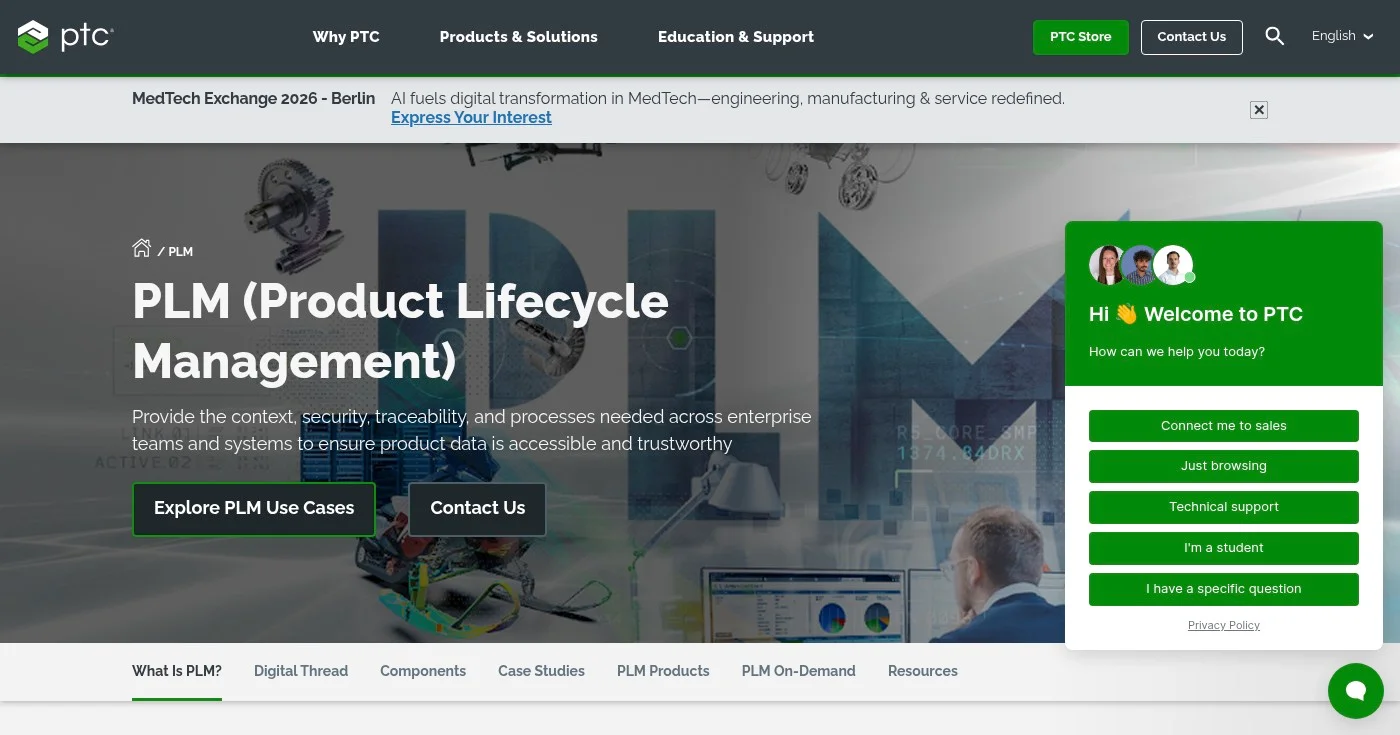
PTC's PLM solutions enable geographically dispersed teams to manage a product's entire lifecycle from concept design through manufacturing, delivery, and service. PTC offers multiple PLM platforms including Windchill, Windchill+, Arena, and FlexPLM, tailored for startups, mid-sized companies, and Fortune 500 enterprises.
PTC Windchill excels at creating a digital thread strategy that connects critical product data across enterprise systems. The platform integrates with ERP, MES, CAD, AR, and IoT technologies to provide context, security, traceability, and processes needed to ensure product data is accessible and trustworthy across teams.
PTC offers multiple PLM solutions tailored for different organization sizes and industries. Contact PTC directly for pricing information specific to your requirements and deployment preferences.
Best for Supply chain-integrated product development
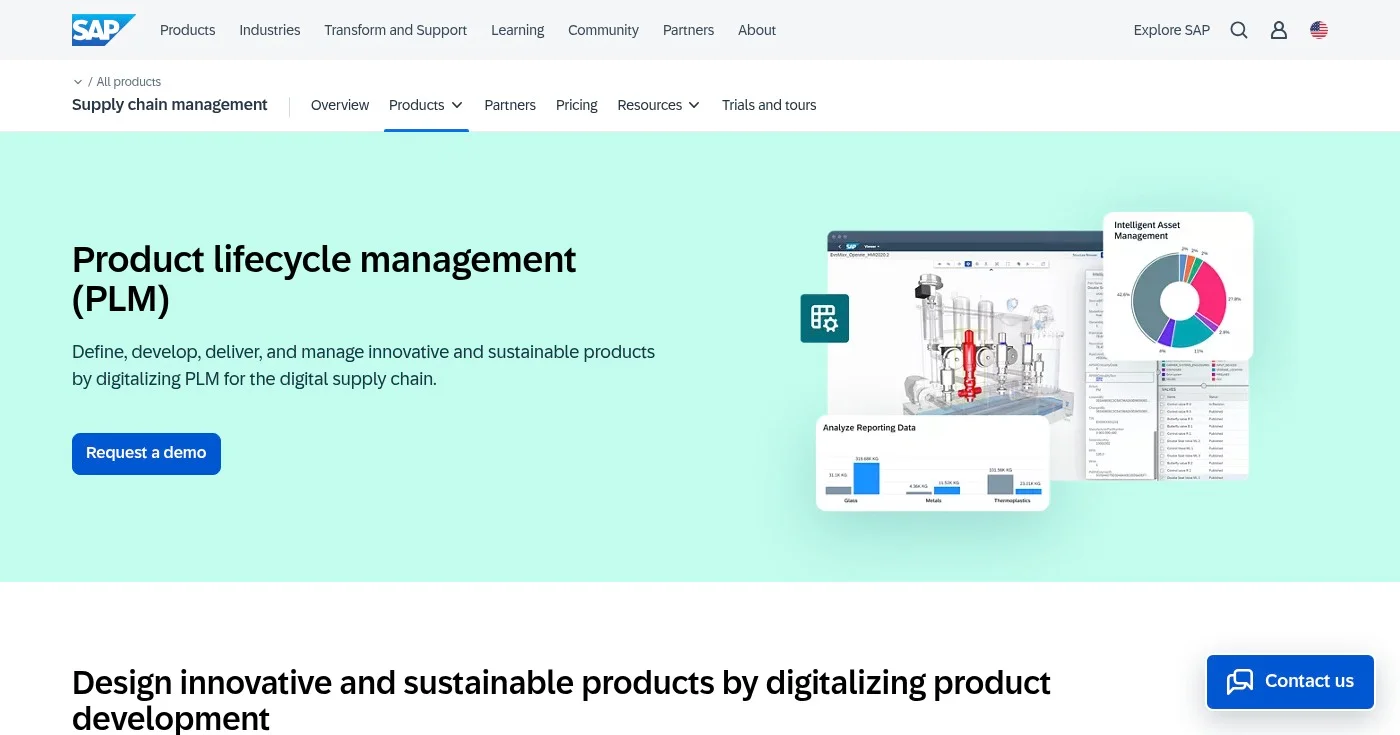
SAP Product Lifecycle Management is a digital solution that helps organizations define, develop, deliver, and manage innovative and sustainable products. The platform digitalizes product development and integrates it with the entire supply chain to improve speed, profitability, quality, and compliance.
SAP PLM stands out for its deep integration with SAP's supply chain management ecosystem, enabling seamless data flow between product development and manufacturing operations. The platform also integrates with major third-party PLM systems like Teamcenter, 3DEXPERIENCE, and PTC Windchill.
SAP PLM is an enterprise-level solution with pricing tailored to your organization's size, industry, and integration requirements. Contact SAP for a detailed pricing proposal.
Best for Small to medium-sized businesses
eQuorum's Product Lifecycle Management software enables organizations to gather product data and production requirements in a central location. The platform manages documents, drawings, and workflow changes throughout the product lifecycle from design through obsolescence.
eQuorum offers both full-featured PLM and a cost-effective PLM Lite solution specifically designed for small to medium-sized businesses. This makes enterprise-grade PLM capabilities accessible to organizations that may find traditional PLM solutions too expensive or complex.
eQuorum offers both PLM Lite for small to medium-sized businesses and full-featured PLM for larger enterprises. Contact eQuorum for pricing details specific to your organization's needs.
Best for Global supply chain standardization
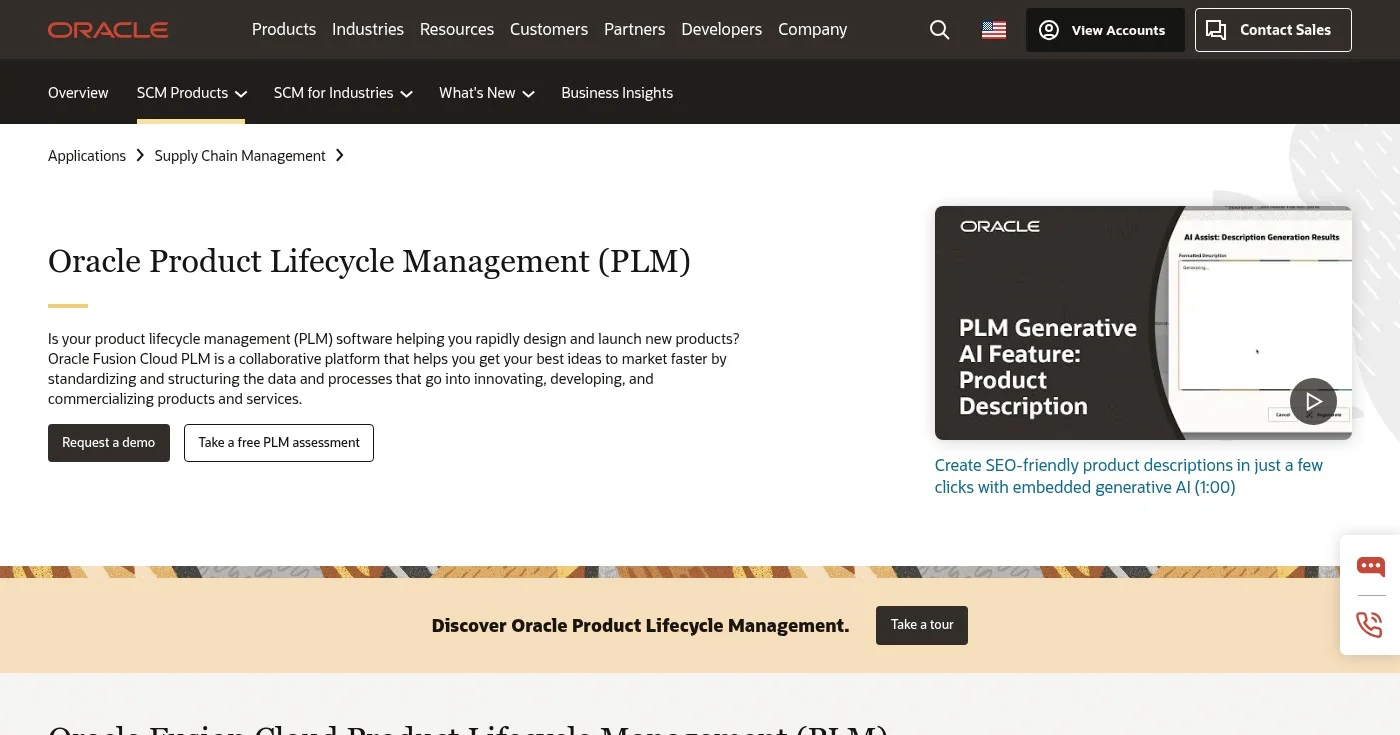
Oracle Fusion Cloud PLM is a collaborative platform that helps organizations rapidly design and launch new products by standardizing and structuring data and processes for innovation, development, and commercialization. The platform efficiently manages items, parts, products, documents, requirements, and engineering change orders across globalized supply chains.
Oracle PLM excels at product master data management and integrates seamlessly with CAD systems to provide comprehensive visibility across the product lifecycle. The platform is particularly strong for organizations managing complex global supply chains with multiple manufacturing sites.
Oracle Fusion Cloud PLM is an enterprise cloud-based solution with pricing tailored to your organization's size and requirements. Contact Oracle for a customized quote.
Best for Industry-specific product development workflows
Aptean offers industry-specific Product Lifecycle Management software designed to streamline new product development. The platform helps businesses seamlessly manage interconnected elements of NPD, design appealing offerings, and accelerate time to market with tailored solutions built by industry experts.
Aptean's key differentiator is its focus on industry-tailored PLM solutions rather than generic platforms. The company's technical experts have deep domain knowledge in specific industries, enabling pre-configured workflows and features that address unique sector requirements.
Aptean offers industry-specific PLM solutions with pricing based on your sector, organization size, and requirements. Visit their pricing page or contact sales for a customized quote.
Best for Multi-domain digital innovation platforms
Siemens Teamcenter is a digital innovation platform that accelerates innovation across domains while connecting critical business areas. The platform delivers applications with both breadth and depth to enhance core product development processes.
Teamcenter is part of Siemens' comprehensive PLM portfolio and is designed for organizations that need to manage complex, multi-domain product development. The platform connects mechanical, electrical, software, and simulation domains into a unified environment.
Siemens Teamcenter is an enterprise-level digital innovation platform with pricing based on your organization's size, industry, and deployment requirements. Contact Siemens for detailed pricing information.
Best for Discrete manufacturing operations
Infor PLM Discrete is a product lifecycle management solution specifically designed for discrete manufacturing industries. The platform has earned strong composite and customer experience scores, indicating high user satisfaction and comprehensive functionality.
Infor PLM Discrete is tailored for manufacturers producing distinct items such as automobiles, electronics, machinery, and consumer goods. The platform addresses the unique challenges of discrete manufacturing, including complex BOMs, engineering changes, and supplier collaboration.
Infor PLM Discrete offers enterprise pricing tailored to discrete manufacturing organizations. Contact Infor for a customized quote based on your specific requirements.
Selecting the ideal PLM software depends on your organization's size, industry, technical requirements, and growth plans. Consider these key factors:
Common Misconceptions: A common misconception is that PLM software is only for large manufacturers. Modern cloud-based solutions like eQuorum PLM Lite and Atlassian PLM make enterprise-grade lifecycle management accessible to small and medium-sized businesses at affordable price points.
The PLM software market is evolving rapidly with several key trends shaping the future of product lifecycle management:
Product lifecycle management (PLM) software is a system that manages a product's entire journey from initial concept and design through manufacturing, distribution, service, and eventual retirement. PLM platforms centralize product data, automate workflows, enable cross-functional collaboration, and provide version control and traceability. They help organizations reduce time-to-market, improve product quality, ensure regulatory compliance, and minimize development costs by creating a single source of truth for all product-related information across engineering, manufacturing, and supply chain teams.
Multiple tools are used for PLM depending on organization size and industry. Leading solutions include Siemens PLM and Teamcenter for large manufacturers, Arena Solutions for cloud-native collaboration, PTC Windchill for digital thread integration, SAP PLM for supply chain-integrated development, and Oracle Fusion Cloud PLM for global operations. Small to medium-sized businesses often choose eQuorum PLM Lite or Atlassian PLM (which offers a free Jira Product Discovery plan). Industry-specific options include Aptean PLM for tailored workflows and Infor PLM Discrete for discrete manufacturing.
Jira itself is primarily a project management and issue tracking tool, but Atlassian offers PLM capabilities through its broader ecosystem. Atlassian's PLM solution integrates Jira with other tools to manage product lifecycles across design, development, manufacturing, and distribution phases. The platform includes Jira Product Discovery (available for free) for product planning and roadmapping. While Jira can support PLM workflows, it's best suited for agile teams already using the Atlassian ecosystem rather than as a standalone, full-featured PLM platform like Siemens or PTC Windchill.
While Boeing's specific PLM implementation details are not publicly disclosed in standard product information, large aerospace manufacturers like Boeing typically use enterprise-grade PLM systems such as Siemens Teamcenter or PTC Windchill. These platforms are designed for complex, multi-domain product development common in aerospace, offering requirements management, configuration control, regulatory compliance, and supplier collaboration capabilities. Aerospace companies require PLM solutions that support ITAR/EAR export controls, AS9100 quality standards, and extensive traceability—features offered by platforms like Arena Solutions and Siemens PLM.
The right PLM software can transform your product development process by centralizing data, streamlining collaboration, and accelerating time-to-market. For large enterprises with complex requirements, platforms like Siemens PLM, SAP, and Oracle Fusion Cloud PLM offer comprehensive AI-powered capabilities and deep enterprise integration. Mid-sized organizations may find cloud-native solutions like Arena Solutions or PTC Windchill provide the best balance of functionality and deployment speed. Small to medium-sized businesses should consider cost-effective options like eQuorum PLM Lite or Atlassian's free Jira Product Discovery to get started with lifecycle management without significant upfront investment. Evaluate your specific industry requirements, integration needs, and budget constraints to select the PLM solution that best supports your product innovation goals.
Dovetail review for UX research: buy Enterprise if you'll staff the repo. Free is $0 for one project. Vendr median $21,600/year.

Hotjar review for UX researchers: heatmaps show what happened on the live page; surveys ask why. Live pricing, sampling limits, and when Clarity is enough.
13 AI wireframe generators ranked by output type, with real free-tier limits, pricing comparisons, and hands-on picks for UX designers and product teams.
