
12 Customer Insight Tools UX Teams Actually Use
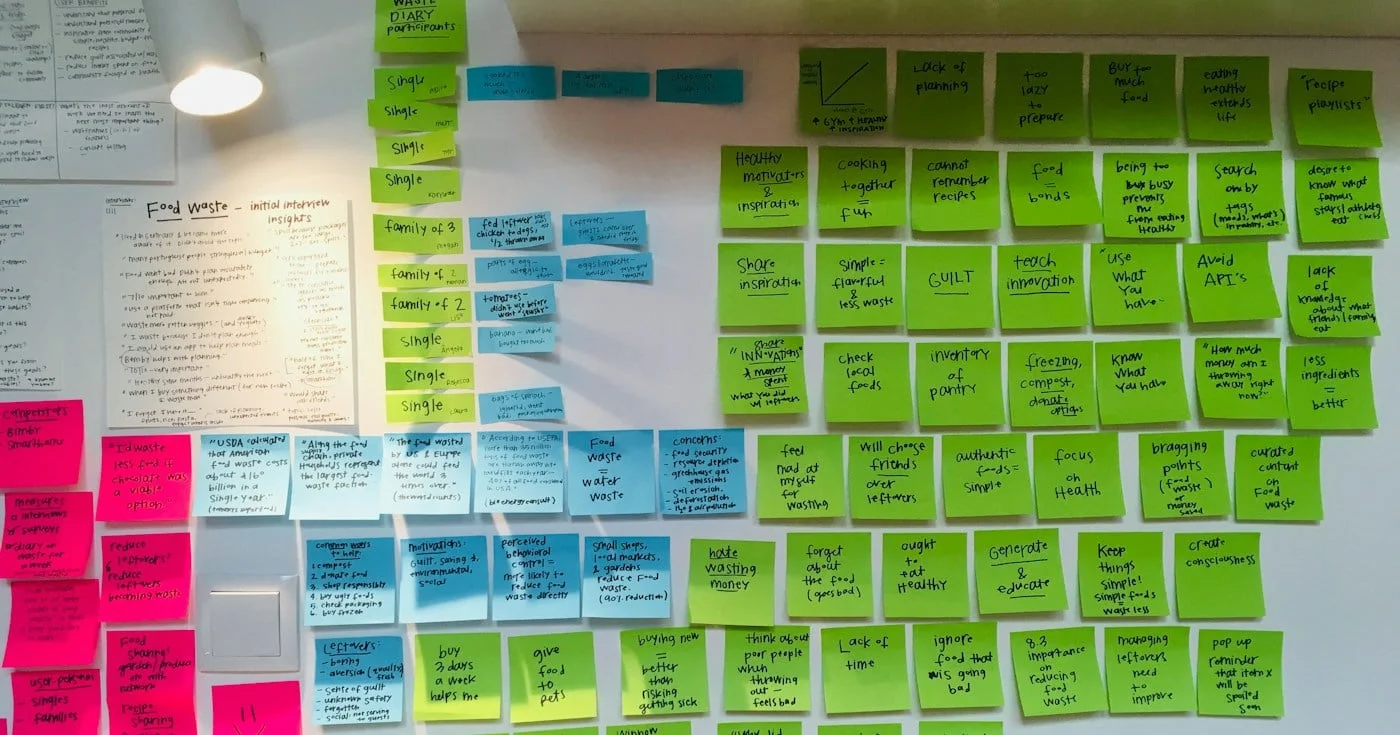
12 customer insight tools for UX teams heading into 2027, with pricing checked on vendor pages in November 2026 and a framework for your research stack.
Updated 18 min read

12 customer insight tools for UX teams heading into 2027, with pricing checked on vendor pages in November 2026 and a framework for your research stack.
For most UX teams, the core customer insight stack is three tools. Dovetail organizes and analyzes research, Hotjar shows what users do on your pages, and Maze runs usability tests from recruiting to report. Below are 12 tools grouped by what UX teams actually do with them, with pricing checked on each vendor's own page in November 2026.
Grand View Research values the customer analytics market at $17.0B in 2025 and projects $70.3B by 2033. In Maze's research survey, teams that fed research into both product and business decisions saw 2.7x better outcomes than teams that rarely used it.
Each tool was assessed across four dimensions relevant to UX and product teams:
Before choosing a tool, identify which listening channel your team needs most. Most UX teams operate across two or three channels and need at least one tool from each active channel.
Channel | What You Learn | Example Tools |
|---|---|---|
Behavioral analytics | What users do (clicks, scrolls, session paths) | Hotjar, Clarity, Amplitude, Mixpanel, FullStory |
UX research platforms | Why users behave as they do (usability testing, interviews) | Maze, UserTesting, UXTweak |
Research repositories | How to organize and reuse insight across studies | Dovetail |
Survey and feedback collection | What users say explicitly (NPS, CSAT, in-app surveys) | Qualaroo, Qualtrics, Medallia |
No single tool covers all four channels at depth. The right stack depends on which channels are most underserved in your current research program.
Every AI-powered synthesis tool on this list has a ceiling determined by what you fed it. Short open-text survey responses (a common reality in B2B SaaS) produce thematic clustering that yields noise, not pattern.
This matters before you invest in tools like Dovetail Channels, FullStory StoryAI, or Qualtrics text analytics. An AI synthesis layer pays off only when the underlying collection is rich: unmoderated think-aloud sessions, transcripts from structured user interviews, or NPS verbatims with follow-up prompts. If your team's primary data source is multiple-choice surveys and form completions, adding AI analysis won't fix the signal problem.
Fix collection first. Then choose synthesis tools.
Software | Best For | Key Features | Pricing | Free Plan | Platforms |
|---|---|---|---|---|---|
Research repositories | Channels, Chat, Agents, Digital Twins, MCP | No (30-day trial on Gold) | Web | ||
Behavioral analytics + surveys | Heatmaps, session replays, funnels, surveys | Yes | Web | ||
End-to-end UX research | Prototype testing, AI moderator, 20M+ panel | Yes | Web | ||
Free behavioral analytics | Session recordings, heatmaps, AI chat | Free | Yes | Web, Mobile | |
Product analytics at scale | Funnels, retention, session replay, experiments | Yes | Web, Mobile | ||
Event-based analytics | Funnels, cohorts, session replay, Mixpanel AI | Yes | Web, Mobile | ||
Enterprise human insight | 7M participants, AI summaries, live interviews | No | Web, Mobile | ||
Enterprise experience analytics | Session replay, StoryAI add-on, Conversion Maps | No | Web, Mobile | ||
Affordable UX research | Tree testing, card sorting, prototype testing | Yes | Web | ||
Enterprise VoC programs | XM Discover, synthetic panels, NPS, CSAT | No | Web | ||
Targeted in-app surveys | Nudge surveys, advanced targeting, NPS | Yes | Web, Mobile | ||
Enterprise multi-touchpoint CX | EDR pricing, text and speech analytics, case management | No | Web |
All 12 customer insight tools compared
Prices as shown on each vendor's pricing page in November 2026. Hotjar and UXTweak showed euro prices to our European visit.
Best for UX teams building an organization-wide customer intelligence hub
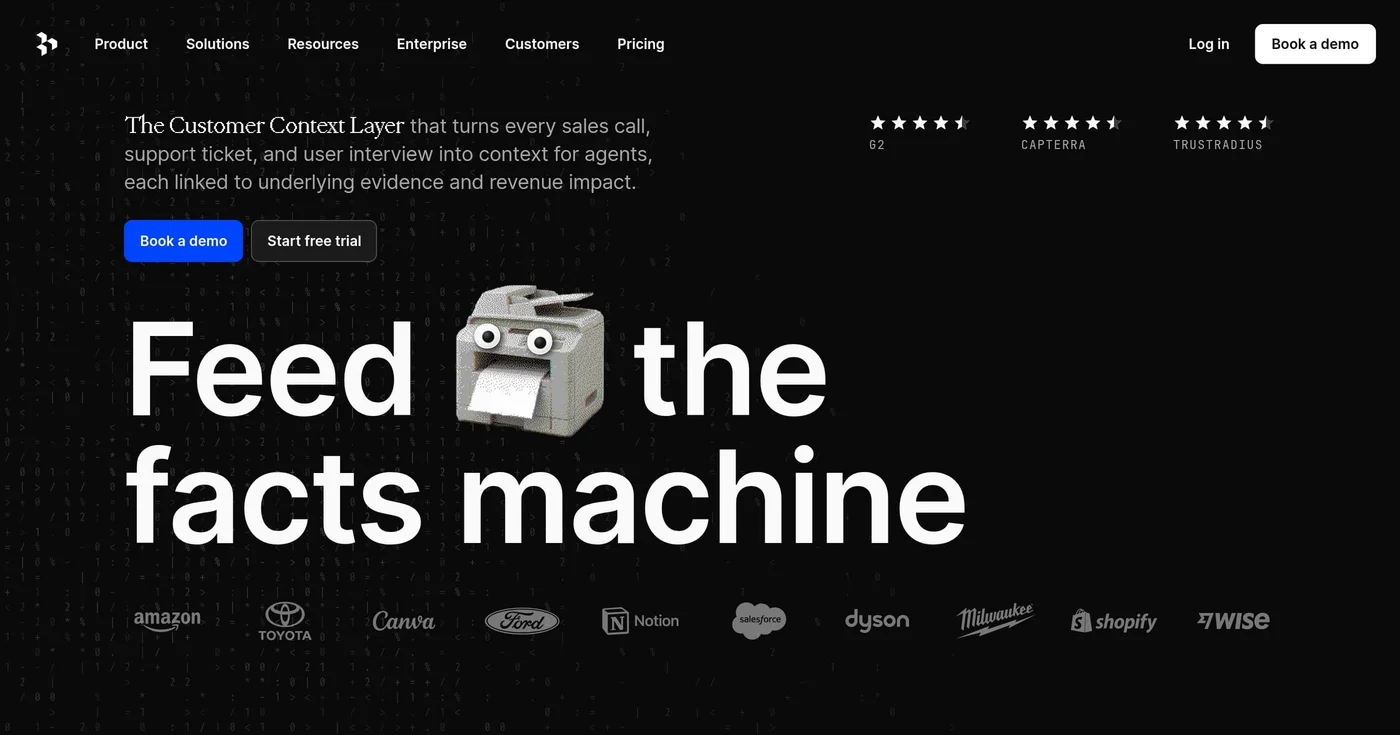
Dovetail started as a research repository and is now pitched as a customer context layer for every team. In October 2025 it launched Agents and Digital Twins, and on November 6, 2026 it launched Dovetail One, one platform for voice of customer, product and design, user research, and revenue teams. It pulls feedback from more than 40 sources, including support tickets, sales calls, surveys and reviews.
Channels is what separates Dovetail from a plain repository. Channels turns high-volume feedback into ranked ideas backed by evidence. For teams running continuous discovery, this replaces the quarterly "digest and tag" sprint with a feed that keeps itself current.
66% of teams in Maze's 2026 survey saw demand for research rise over the past 12 months. Dovetail is built to answer that demand across the company, not just inside the research team.
See Dovetail pricing for current details, or read our full Dovetail review.
Best for web product UX teams mapping user behavior and collecting in-context feedback
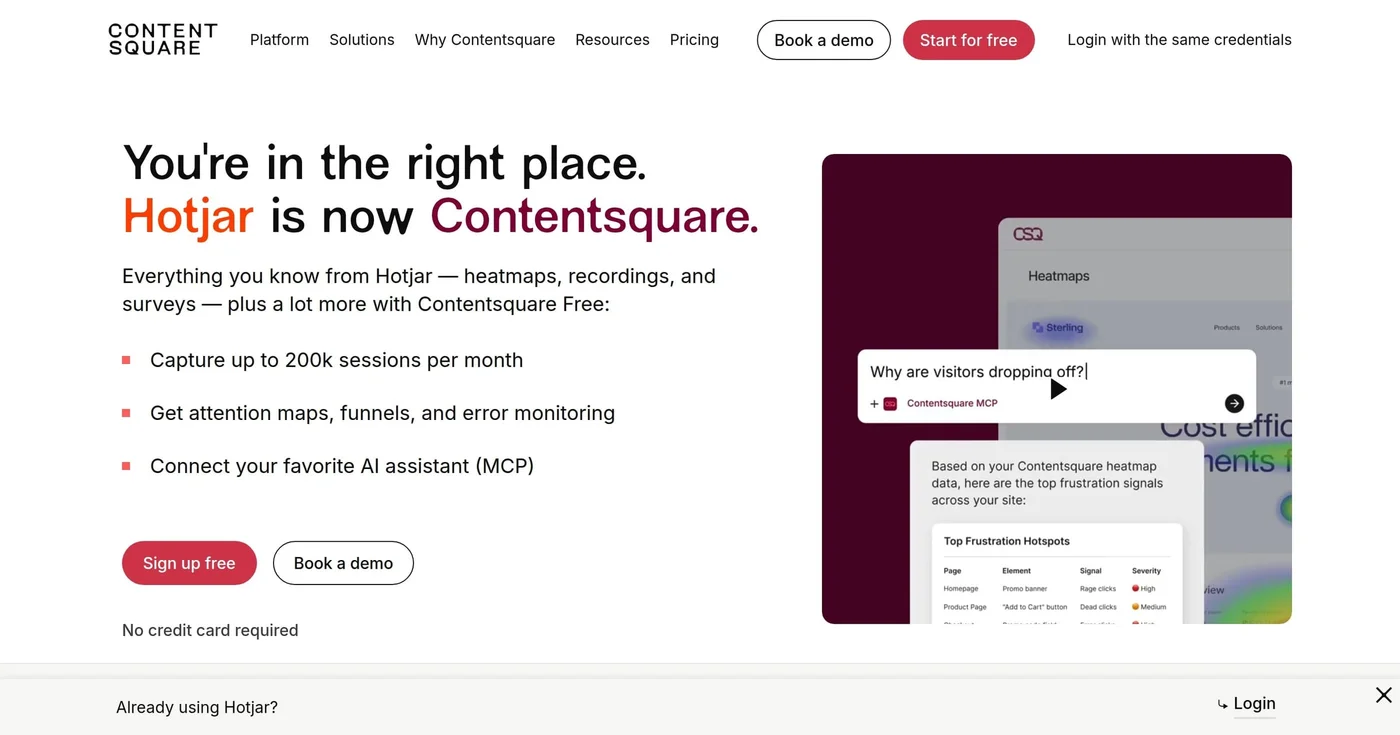
Hotjar puts heatmaps, session replays, funnels and on-site surveys on one dashboard. Its free plan covers up to 200k monthly sessions with no credit card required.
In September 2021, Contentsquare acquired Hotjar, and Hotjar's homepage now says "Hotjar is now Contentsquare." Hotjar's pricing page now opens Contentsquare's Experience Analytics plans, which "include all your favorite Hotjar tools." Pro and Enterprise sit on Contentsquare's Experience Platform, so budget for a sales call if you outgrow Growth.
The Growth plan adds Sense AI chat plus session replay and heatmap summaries, which surface patterns you would otherwise find by watching recordings one by one.
Prices shown in euros on our European visit. See Hotjar pricing for current details, or read our Hotjar review.
Best for UX researchers running moderated and unmoderated usability studies end-to-end
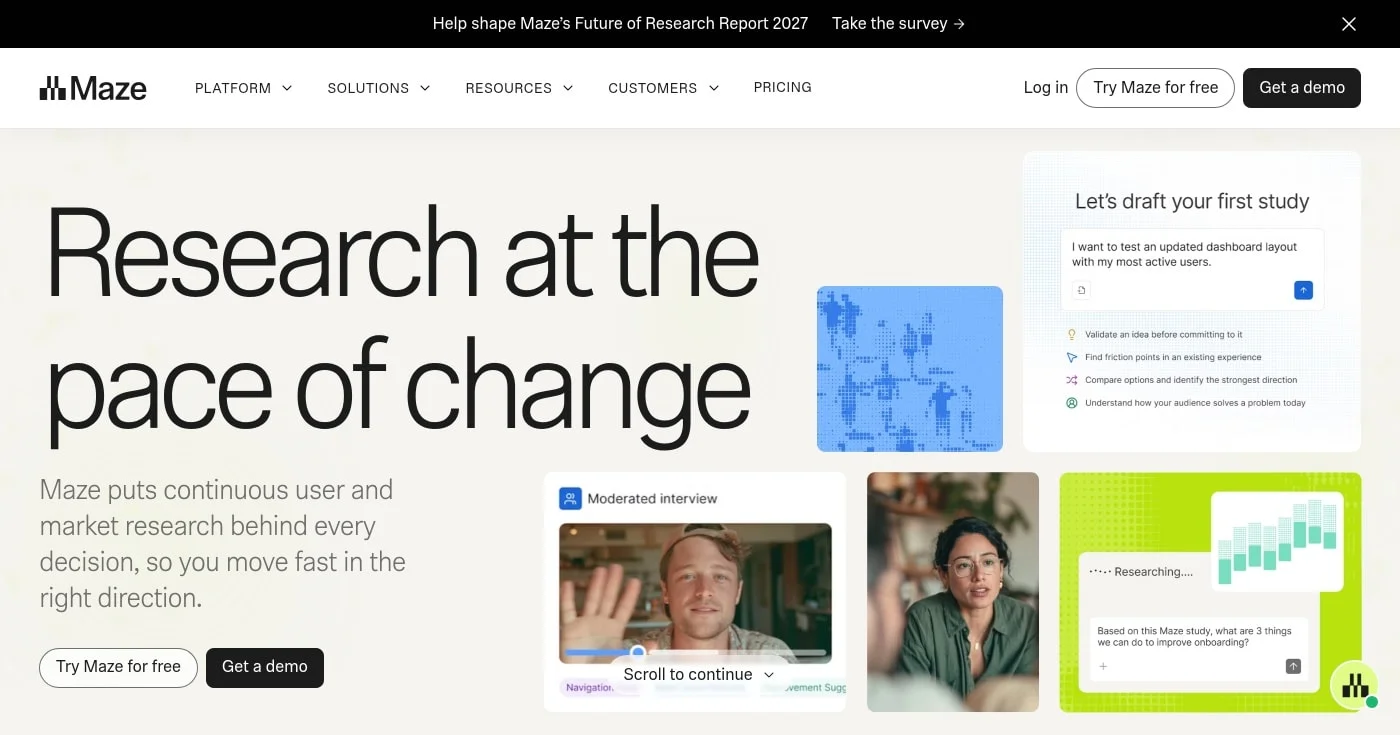
Maze covers the UX research cycle on one platform: recruit participants, run prototype and live website tests, run card sorts and tree tests, host moderated interviews, and generate presentation-ready reports. Enterprise plans include access to a panel of 20M+ participants, or you can bring your own users for free.
The AI moderator, launched in September 2025, plans, runs and analyzes user interviews for you, while you set the goals and own the study. In Maze's 2026 survey, 69% of teams used AI in at least some of their studies.
No self-serve paid tier is listed on the public pricing page.
Best for any team that needs behavioral analytics without a budget
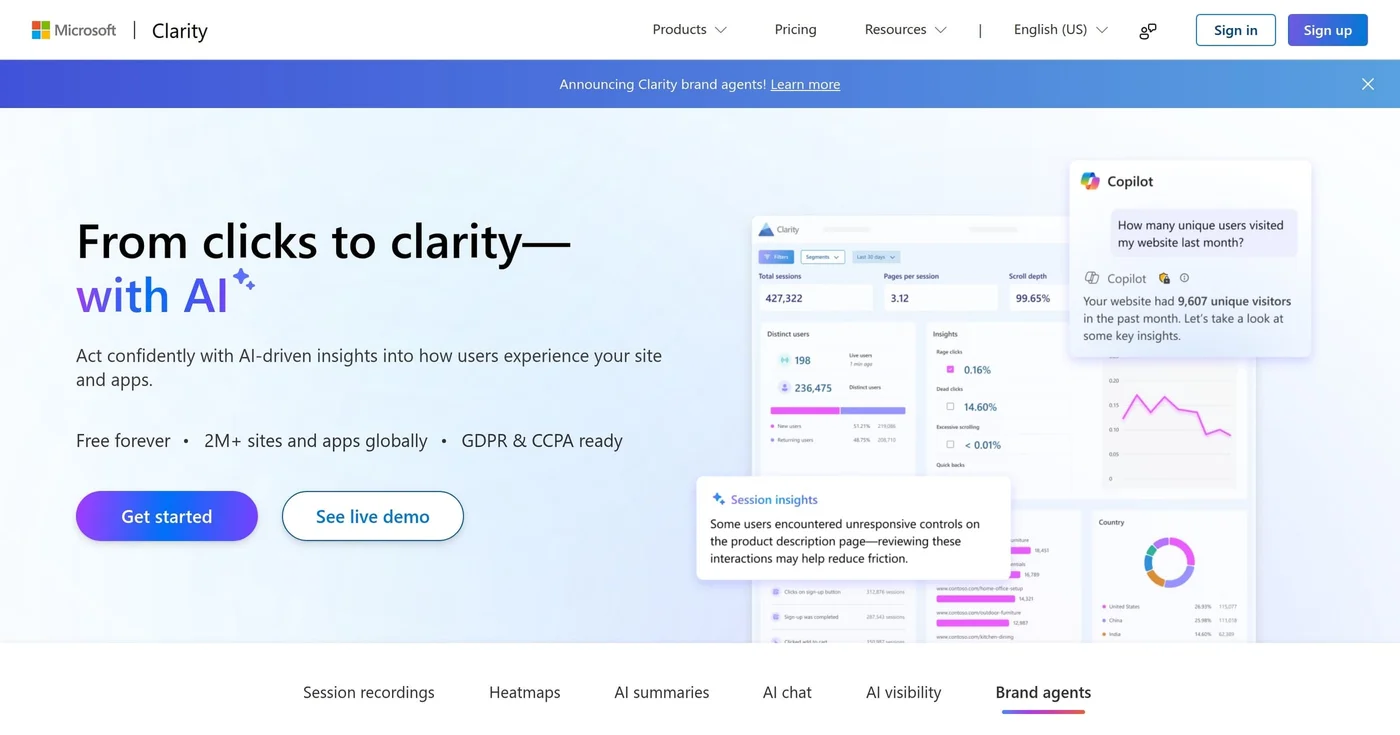
Microsoft Clarity is free forever, with no limits on traffic and no per-seat fees. Microsoft says 2M+ sites and apps use it. Its "Chat with your data" feature turns plain-language questions into data-backed answers, so you spend less time watching recordings.
Clarity has added AI features beyond replays. AI visibility reports show when AI experiences cite your content and which AI bots crawl your site. Brand Agents put an AI shopping assistant for your brand on your website.
Clarity's ceiling: it tells you where users click and scroll, but not why.
No credit card required. See Microsoft Clarity for setup.
Best for SaaS product teams measuring retention and feature adoption at scale
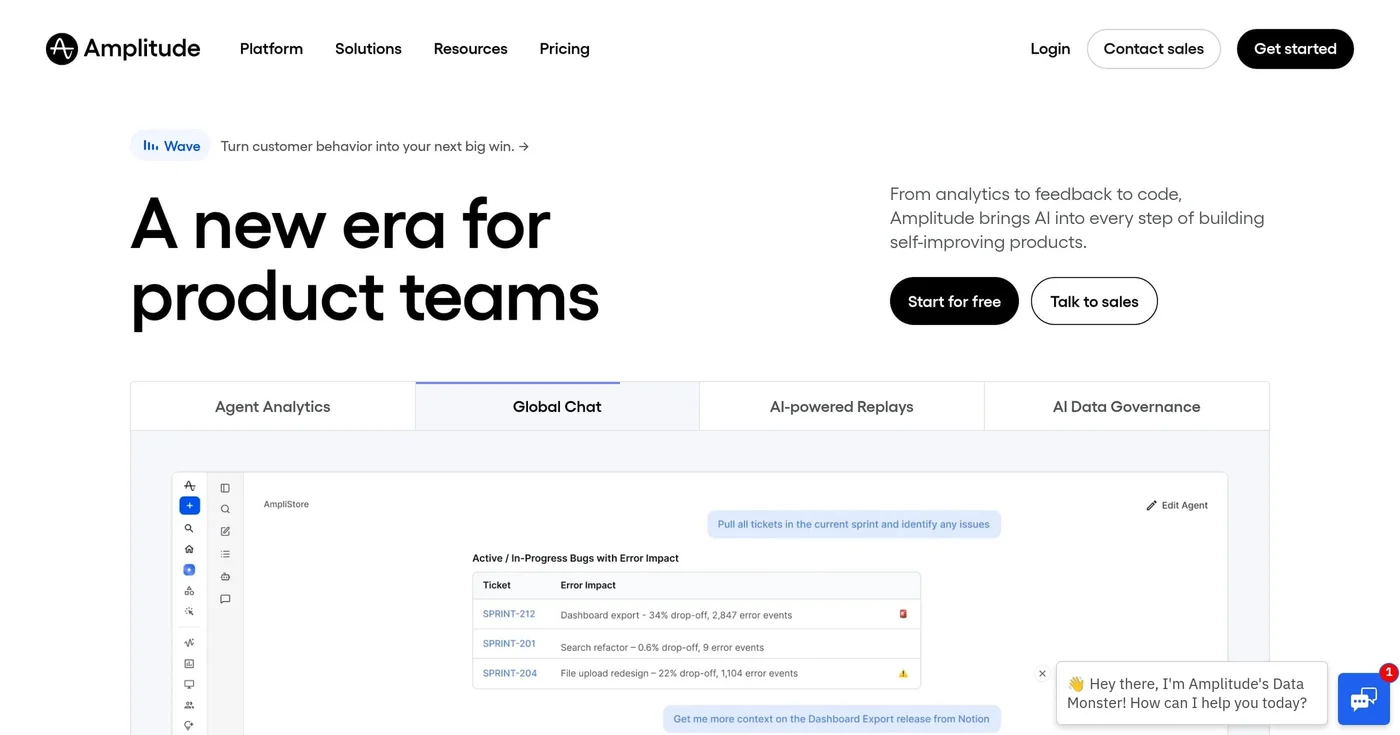
Amplitude is purpose-built for product analytics: event tracking, user journey analysis, behavioral cohorts, and retention measurement across the full product lifecycle. Unlike Hotjar (which works at the page level), Amplitude is event-driven: you track what users do across sessions, devices, and time, then build cohorts based on behavioral patterns.
The free plan includes 2M events a month, AI Agents and MCP, 2,000 AI feedback records and 10K monthly session replays, with unlimited seats on every plan. Session replay adds behavioral context that pure event data misses.
In Maze's 2026 survey, research was essential to strategy and operations in 22% of organizations, up from 8% in 2025. Amplitude gives product teams the quantitative grounding to decide which qualitative questions to research next.
See Amplitude pricing for current details.
Best for digital product teams that want event-based analytics with minimal upfront cost
Mixpanel offers a free plan with up to 1M events a month, 10K session replays a month and unlimited seats. Mixpanel says it is trusted by 29,000+ companies, and it suits teams in the startup-to-growth stage where event volume is high but budget is tight.
Every plan includes Mixpanel AI, session replay, heatmaps, experiments and feature flags, so you don't need a second tool for replays. The startup program gives companies founded less than 5 years ago, with up to $8M in total funding, their first year free on the Startup Plan.
See Mixpanel pricing for current details.
Best for enterprise UX teams needing validated human insight at scale
UserTesting is built for enterprise human insight. Its network page lists 7 million qualified participants, and in January 2026 it acquired User Interviews, the participant recruitment platform. It offers unmoderated tests (think-out-loud, interaction tests, surveys) and moderated Live Conversation interviews.
AI-generated Insight Summaries condense video feedback into findings, with sentiment analysis and transcripts to find the moments that matter. Click maps and interactive path flows add a quantitative layer to qualitative sessions. Two pricing models fit different programs: Test-based Consumption (pay for what you use) and Team-based Unlimited (predictable cost for high-volume programs).
No self-serve pricing is published. UserTesting is designed for enterprise budgets.
Best for enterprise teams with data science needs and the deepest behavioral analysis requirements
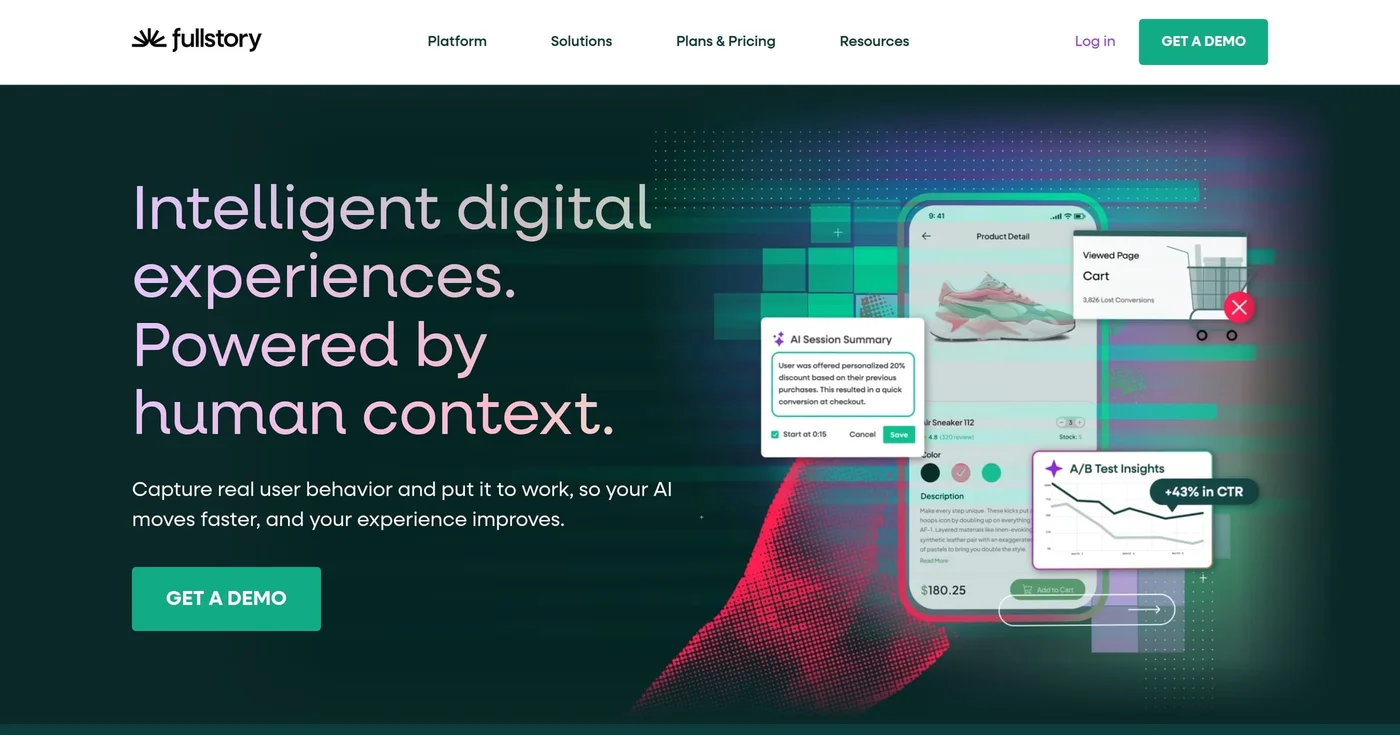
FullStory is a digital experience analytics platform for enterprise teams. Beyond session replay and heatmaps, its plans include Conversion Maps and Page Flow analysis for finding where journeys break.
StoryAI, sold as a plan add-on, is a system of AI agents that surfaces insights from behavioral data and predicts behavior. The Enterprise plan is aimed at data science and analytics teams that build predictive models or use the data for GenAI and LLMs.
No published starting price. FullStory targets mid-market and enterprise product teams.
Best for small UX teams and startups that need research breadth at startup prices
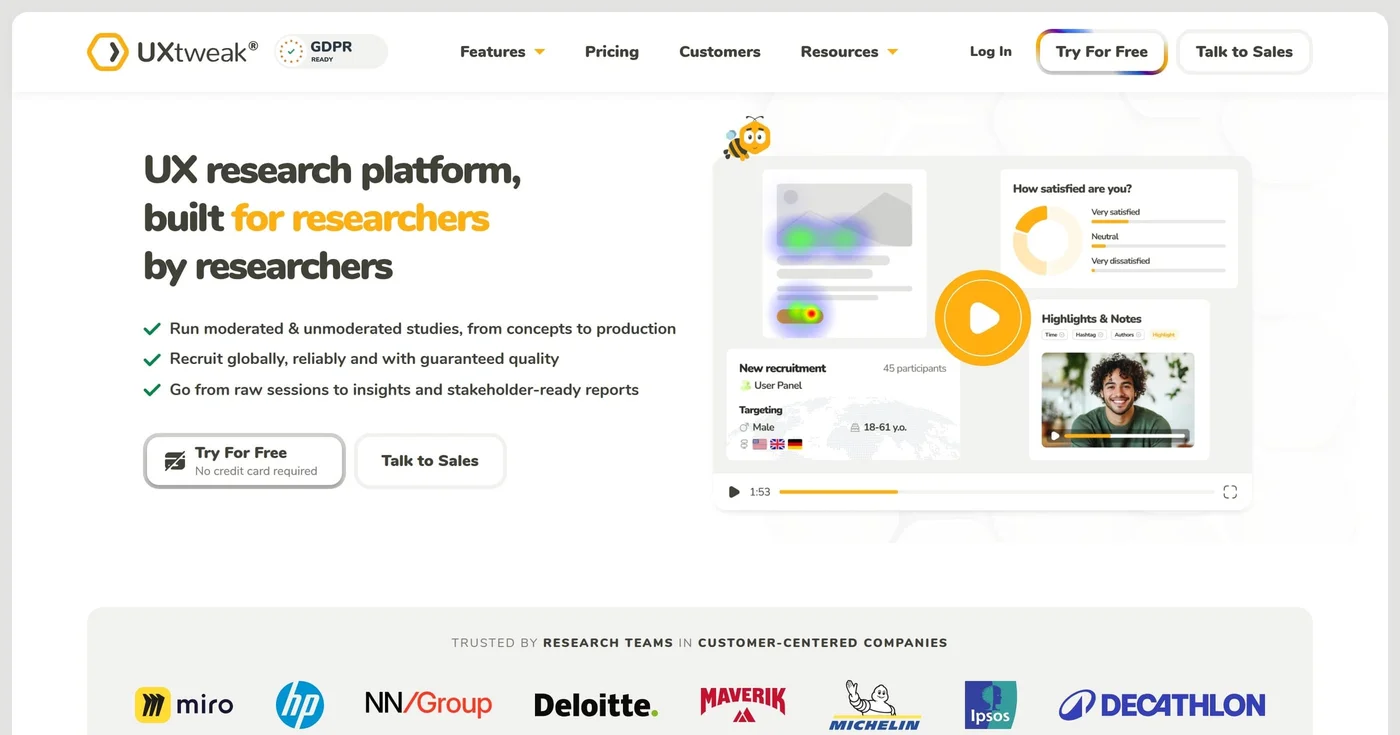
UXTweak covers the core UX research methods (tree testing, card sorting, prototype testing, website testing, session recordings, and live interviews) at a lower entry price than Maze or UserTesting. The Business plan costs €120/mo billed annually and gives a small team access to most features without enterprise negotiation.
For teams running moderated and unmoderated research in parallel, UXTweak's User Panel lets you recruit participants with demographic targeting. Business includes 12 moderated studies a year, with unlimited moderated studies as an add-on. The free plan's 15 responses per month is an evaluation tier, not a production tool, but it's enough to validate the platform before committing.
Prices shown in euros on our European visit. See UXTweak pricing for current details.
Best for enterprises running scaled voice-of-customer programs across multiple business units
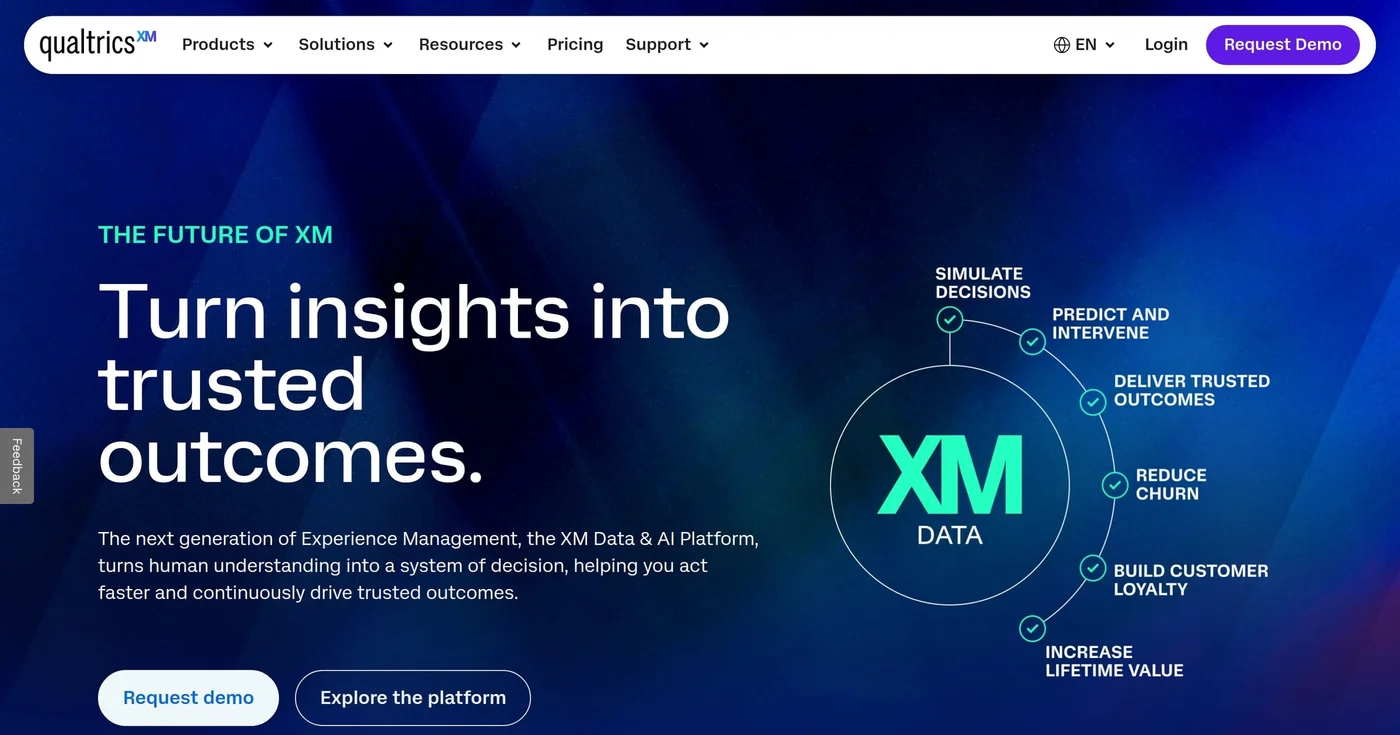
Qualtrics is an enterprise experience management platform. Its XM Discover product analyzes customer feedback from conversations across channels, including cases, chat and voice transcripts. In March 2026 Qualtrics added synthetic panels for US consumers, which simulate how consumers would answer research questions; Qualtrics says its model is 12x more accurate than general-purpose AI at matching human responses.
Qualtrics serves CX, EX, and Market Research programs simultaneously, which matters for enterprise organizations where research insights need to flow across HR, product, and marketing. It holds FedRAMP High authorization, which matters for public sector teams.
Qualtrics targets enterprise organizations with dedicated CX programs.
Best for product teams that need to survey specific user segments at exactly the right moment
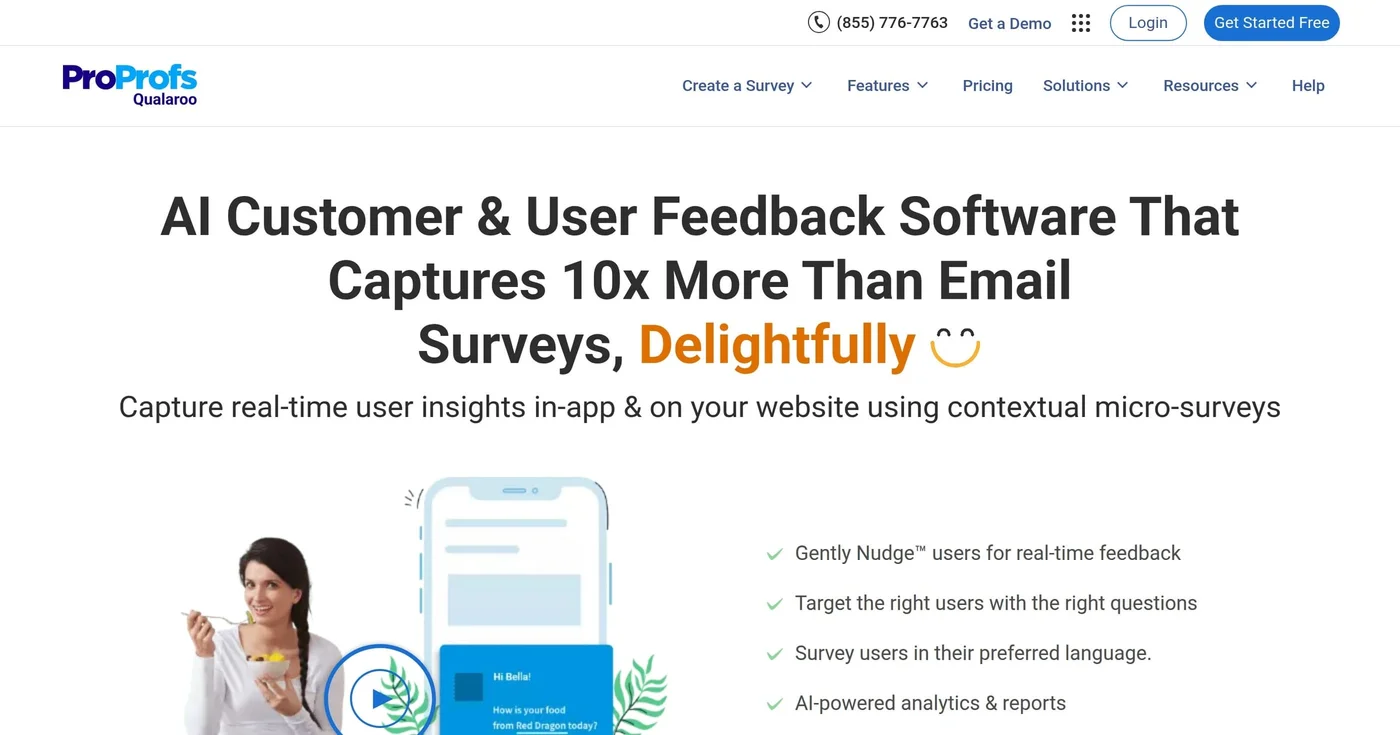
Qualaroo is built around a concept called Nudge™: a small, unobtrusive survey that appears to the right user, on the right page, at the right moment. You can target by user identity, behavior, cookies, custom properties, or location. Exit-intent triggers capture feedback from users about to leave: one of the highest-signal moments in any UX feedback loop.
This targeting granularity is what separates Qualaroo from generic survey tools. You're not running a blanket NPS blast; you're asking the user who just failed your checkout flow what happened. The mobile Nudge™ extends this targeting to mobile browser experiences.
One important note on the free plan: the 50-response cap is a one-time pool, not a monthly reset. Test the platform with a small campaign before committing.
Best for large enterprises managing feedback across dozens of customer touchpoints
Medallia prices by Experience Data Record (EDR): all the data tied to one discrete interaction between a customer (or employee) and a company, priced in annual tiers. Medallia says the model does not penalize you for collecting more data, and every plan includes unlimited users, so frontline teams, not just researchers, can see customer signals.
For large enterprises managing contact center interactions, digital touchpoints, and employee feedback at once, Medallia's alerting, case management and closed-loop workflows send specific insights to the teams that own them, without a central analyst bottleneck.
Medallia is designed for enterprise-scale organizations with dedicated CX programs.
Match your tool choice to the listening channel your team needs most and the research methods you run, then check that the pricing model fits your trajectory:
Dovetail review for UX research: buy Enterprise if you'll staff the repo. Free is $0 for one project. Vendr median $21,600/year.

Hotjar review for UX researchers: heatmaps show what happened on the live page; surveys ask why. Live pricing, sampling limits, and when Clarity is enough.
13 AI wireframe generators ranked by output type, with real free-tier limits, pricing comparisons, and hands-on picks for UX designers and product teams.
