
Product Strategy Starts With What You Will Not Build
Product strategy is where-to-play and how-to-win choices, including the work the roadmap will omit.
Updated 15 min read
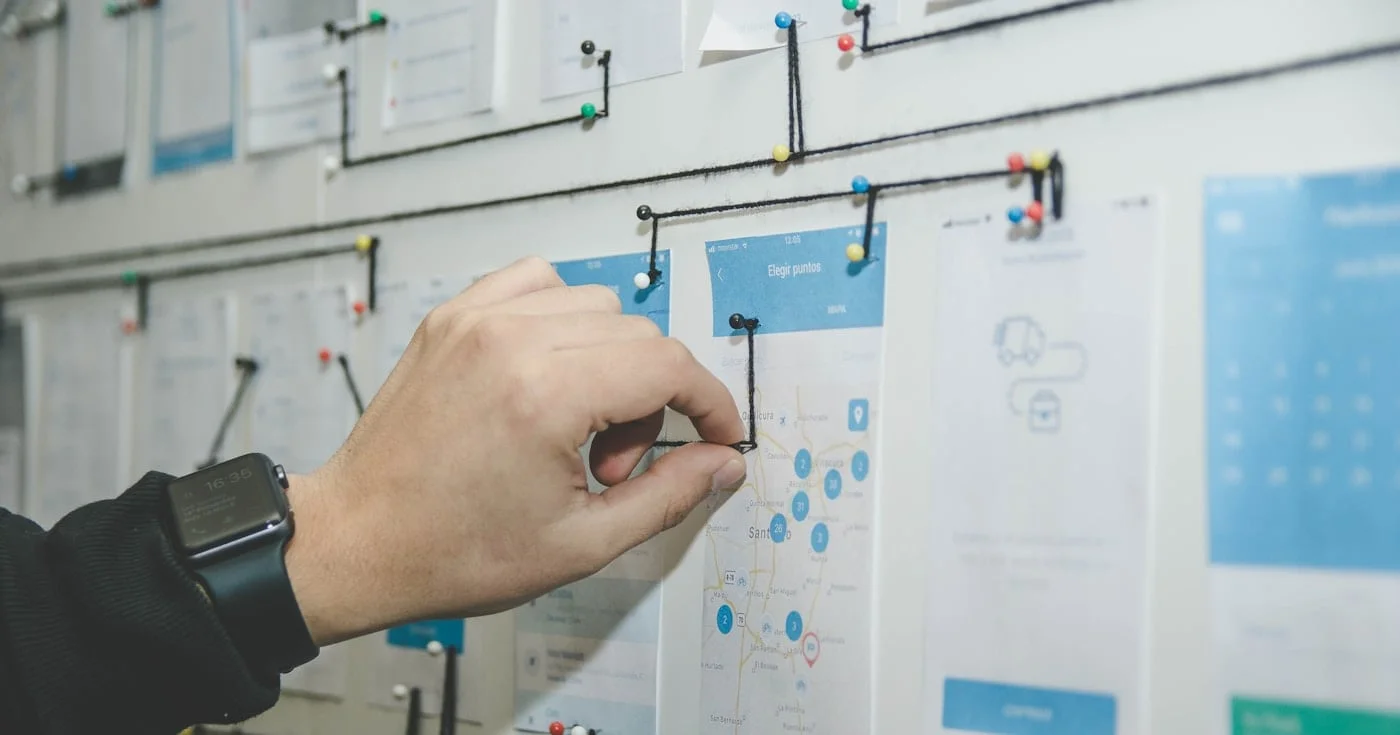

Product strategy is where-to-play and how-to-win choices, including the work the roadmap will omit.
Product strategy is a set of choices about where the product will play, how it will win, and which problems get solved, including the work the roadmap will omit. Ant Murphy wrote that in 2021. Cabin restated it on 29 July 2026: if the paragraph still reads true for any product at any company, you wrote a mission statement.
Marty Cagan still meets teams that hold a revenue goal, a feature list, and nothing in between. Atlassian collapses the same document into a plan that "serves as a roadmap."
This page is for PMs and designers making product decisions. It is a product-choices guide, not a go-to-market plan or a 12-framework zoo.
Ant Murphy googled the term in 2021 and found a dozen articles treating it as "product vision and roadmap." He called that incorrect. After Roger Martin, every choice to do something is also a choice not to.
Cabin puts the 2026 restatement in one sentence: the set of choices that decides what you will build, for whom, and why, so day-to-day decisions get easier instead of harder. ProductPeople draws the same line: a roadmap is the sequence of bets; strategy is the logic behind those bets. If the document does not help you say no, it is positioning copy.
Matthew Mamet is blunter. Without the "what it will not do" clause, you do not have a strategy. You have a wish list.
Marty Cagan gives the job a sharper cut: how do you decide which problems the team should solve? Product discovery finds tactics. Delivery ships them.
Strategy sits above both. Most companies he meets skip it.
On r/ProductManagement, the most-upvoted practical definition in May 2026 matches the independents:
"It's simple: strategy is choice. Choice focused on how you win (however you define what winning is for your product, framed from the users perspective). Winning isn't hitting a certain revenue goal or KPI."
u/TopshelfWhiskey88 in r/ProductManagement (May 2026)
Jackie Bavaro at Asana puts the roadmap inside strategy (vision, framework, roadmap). That conflict lives under the roadmap heading. This page puts choices first.
Building got cheap. ProductPlan quoted Dianne Penn (Head of Product, Anthropic research) in July 2026: when teams can ship in days, the quality of the decisions is what sets you apart. The remaining job is which of those things are worth building.
Productboard said the same thing in September 2026 from the other side of the fence: ship an AI feature, feel good for a week, watch two competitors ship it. Building fast stopped being the edge.
User stories still need INVEST and acceptance criteria, and the Kano model still sorts delighters from must-haves. Neither tells you which job is worth a prototype. That call is the strategy.
Cabin stacks three layers. Name which layer you are arguing about when the room goes in circles.
Vision is a years-stable destination. Strategy is the set of choices that should evolve as you learn. The roadmap sequences bets that change most often.
Roman Pichler (v3, last updated 11 May 2026) uses a four-layer stack, bidirectional, and adds the backlog. Strategy is four choices: market, needs, standout features, business goals. Typical horizon is 12-24 months.
Review it at least every three months. After two to three months on a first outcome, check whether the goal was met and whether the strategy is still current. OKRs live on the roadmap, not as the vision.
Shreyas Doshi compressed the stack in November 2021. The labels still work:
Mission: Why Vision: What Strategy: How Segmentation: Who Positioning: Where Roadmap: When
Melissa Perri on Lenny's Podcast: a tagline is not a vision.
"That's like a tagline but it's not a vision. What are we doing, what are we not doing? Who do we want to be when we grow up five to ten years from now?"
Melissa Perri (Lenny's Podcast, 24:09)
Cagan (15 Jul 2016) puts vision at two to five years and quotes Bezos: stubborn on vision, flexible on details. Trying to please everybody pleases nobody.
Perri's working artifact is a two-pager, then nested intents: executives write business intents, directors write problem-oriented product initiatives, teams write solutions. The deploy test: every team should tell a similar story from the ticket to the business metric.
Vision is the layer above. Write it so it can stay still while the bets change.
Roger Martin splits the work that boards love from the work that customers grant:
"Strategy is focusing on outputs and planning is focused on inputs. People love planning because it tends to be about the things that you control."
Roger Martin (Foundstone Conversations, 13:22)
A list of laudable initiatives is still a plan unless the set of choices induces customers to act as an integrated set.
Cagan (18 Feb 2020) still finds organizations listing 20-30 "priorities" instead of 2-3 truly important things. The Pandora case in that essay is the cost of splitting engineering capacity across stakeholder wish lists: IPO around $16, then roughly $8, then a sale.
Focus is the strategy. Stakeholder-split is the absence of one.
Keep the set small. Cabin wants three or four bets a team can hold in their heads. Cagan wants 2-3.
A handful, not a portfolio of 20.
A bet with no sacrifice is a wish. Write the exclusion next to the bet, on the same page, in the same meeting. If the exclusion feels polite, it is not an exclusion.
Melissa Perri will not give you certainty first:
"We don't always make the right choice when it comes to strategy, but you got to make a choice."
Melissa Perri (Lenny's Podcast, 42:13)
Copy the one-pager below into a doc. Fill every row. If a row stays blank, you are not done.
Field | What you write |
|---|---|
Who it is for | Named customer and job, not "users" |
The bet | One-sentence hypothesis for the next 12-24 months |
How it wins | Delight, hard-to-copy, margin (see DHM) |
What you will not do | Named work that dies this cycle |
How you will know | Observable signal, not a slogan |
Melissa Perri (26 May 2026): strategy is direction. It tells you where you are going and what has to be true for you to win. A roadmap is the sequence of solution bets you are making toward that direction.
Then the swap-test: take any item on the roadmap and swap it. If the strategy still holds, the strategy was never real. You had a list of activities wearing a strategy's clothes.
Ant Murphy calls the roadmap a translation layer between strategy and day-to-day work. Cagan (2015) is tired of roadmaps that tell the team what to build. Replace the feature list with product vision plus team OKRs; keep date needs as high-integrity commitments.
His 2022 follow-up with Moore: converting a feature roadmap into an outcome roadmap is necessary and not sufficient. You still have to pick the right problems.
Roger Martin (Feb 2024) will not let OKRs do the strategy's job:
Very few executives understand strategy. That is why OKRs substitute (ineffectively) for strategy.
Use OKRs as a roadmap vehicle if your org already runs them. Do not call the OKR sheet the strategy.
On r/ProductManagement, the working picture is a climb: vision is the summit, strategy is the chosen route plus the risks, the roadmap is the climb. u/GeorgeHarter (May 2026) gets consensus at v1, then stops republishing. After that, strategy is a filter ("does this fit?").
Jackie Bavaro (10 Dec 2022; first PM, then Head of Product Management at Asana) writes three pieces: vision, framework, roadmap. Framework is target market plus product pillars plus principles (Asana: Fast is better than Features; Easy to use AND Powerful).
Roadmap, in her hands, is "not a commitment" and a "wake-up call" that current pace misses the vision. A third try at Asana failed her "that's not a strategy" test because it was missing a roadmap.
She also named a failure mode this page agrees with:
My spicy take on why Google keeps launching and then shutting down products: they have a company strategy, but don’t make product strategies.
Her "strategic roadmap" is a wake-up-call sketch of themes. That is closer to bets than to a feature Gantt. Keep the sequence in the roadmap and the choices in the strategy, so a swap-test has somewhere to land.
Jackie Bavaro (Apr 2022) is useful on the way in: invent at least two strategic approaches that could hit the business goal (new paying customers vs existing customers paying more; if new, which market).
Roadmaps rarely fragment overnight. ProductPlan (July 2026) described the pattern: a regional team prioritizes its customers, another shifts after an executive request, a third answers Sales.
None of those calls is wrong alone. Strategy drifts.
Sequencing, dates, and Now/Next/Later belong on a roadmap page. This one stays on which bets exist and which work is excluded.
Skip the 10-step and 12-framework pages. Three tools cover the job: a nested choice cascade, a fluff detector, and a method a product org actually ran.
Framework | Job on this page | Origin |
|---|---|---|
Playing to Win | Nested where-to-play / how-to-win | Lafley and Martin, 5 Feb 2013 |
Rumelt's kernel | Diagnosis, policy, coherent action | |
DHM | Delight, hard-to-copy, margin |
Melissa Perri's 2016 essay is the independent piece Google still ranks. Use it to kill the feature plan ("to create a platform that allows music producers to upload…" is a plan).
Do not make Toyota Kata the framework H2. Pichler's four choices instantiate where-to-play and how-to-win for a product org. They are not a fourth school.
Five nested choices: Winning Aspiration, Where to Play, How to Win, Must-Have Capabilities, Enabling Management Systems. Lafley and Martin published the cascade in 2013. Martin (20 Feb 2023) calls where-to-play plus how-to-win the heart of strategy, and the last two boxes the reality check.
Must-have capabilities have to pass a can't/won't test. One-box strategy is delusional. Three-box strategy is lazy.
Order is nested abstraction, not a waterfall. Martin (28 Dec 2020): lock where-to-play then invent how-to-win and you will wreck the strategy. Farnam Street quotes the book as a coordinated and integrated set of five choices.
Fill all five. Do not turn this section into a P&G case study.
For a product team, "where to play" is the customer and the job, not a TAM slide. "How to win" is the reason a designer should spend a week on this journey and not that one. If those two boxes do not change which Jobs to Be Done you prototype next, the cascade is decoration.
Good strategy reduces to a kernel: diagnosis, guiding policy, coherent action. Richard Rumelt wrote it that way. The live primary for the 2011 hallmarks essay is McKinsey's reprint (1 Jun 2011), byline Rumelt.
Hallmarks of bad strategy, from that essay: failure to face the challenge, mistaking goals for strategy, bad strategic objectives, and fluff. The worked joke is Chad Logan's "20/20 plan" (20% revenue growth, 20% profit margin).
The Pacific Northwest mayor published 47 strategies and 178 action items. Action item 122 was "create a strategic plan."
Cagan quotes Rumelt: bad strategy is the active avoidance of the hard work of crafting a good strategy. SVPG adds that good strategy does not pop out of a matrix.
SVPG on management: no product strategy survives its initial encounter with the real world. Run the kernel as a fluff detector on whatever cascade you just filled. If the diagnosis is "grow," you do not have a diagnosis.
How will your product delight customers in hard-to-copy, margin-enhancing ways? Gibson Biddle asked that as Netflix VP of Product from 2005 (he left for Chegg in 2010). Combine D+H+M in a single hypothesis.
A bet that only delights is a feature. A bet that only raises margin is a tax. A bet that is hard to copy and delights no one is a science project.
Netflix ran about 4-6 product strategies per year. Of a dozen high-level bets Biddle listed across fifteen years, half failed. Named misses from that table: Friends/social; unique movie-finding previews; Red Envelope Studios (exclusive content, 2007); Max the animated host.
Winners stacked all three legs: personalization, streaming, the device ecosystem, original content.
The 12-step TLDR Exercise #4 still asks for 4-6 high-level hypotheses you would like to test in the next year or two. Treat later Netflix moves (ads, paid sharing, yield) as Maureen Kerr's 2026 sequence, not as Biddle's DHM table.
Ant Murphy (21 Oct 2025) keeps four steps: gather inputs, write strategic narratives (insight plus a hypothesis about the future), name how-to-win, then make the choices. Litmus: if the choices do not feel hard, they are probably not the right choices.
Pichler (12 Jan 2026) on existing products: describe the current strategy first.
On r/ProductManagement, the messy multi-product brief keeps coming back. Name point A and point B. Decide what "growth" actually means.
Ask whether keeping all four products is itself the strategy.
In June 2026, u/AllTheUseCase argued the heretical version: products do not hold strategy in a vacuum. The enterprise does. At a firm like Google, company strategy is the starting point.
Derive the product choices from a communicated company diagnosis. Do not invent them in a workshop that has never seen it.
A practical sequence for a PM and a designer in the same week:
The pet-project tactic from r/ProductManagement is ugly and it works: force the requester to own the outcome math.
Atlassian still says the document "serves as a roadmap." monday.com uses the same sentence. You end up with dates and no exclusions.
Run Perri's swap-test. If every epic can rotate and the "strategy" still reads true, you have a schedule.
Rumelt already named this: 20% growth is a hope. "Double revenue" is the goal Cagan keeps finding with no strategy underneath. Write the constraint you are actually facing (channel cost, switching cost, a job you do not serve) before you write the number.
Designers feel this as a board of user stories that all say P0. Cut until a teammate can recite the bets without opening the doc.
On r/ProductManagement this is the death story, not a theory:
"Our team was screaming for a strategy to align their development, roadmap and sales activities. So we sat down and created one, which would focus our resources on our core business. Two weeks later sales lead came around the corner with a new opportunity they went to and promised the world."
u/Funkymeleon in r/ProductManagement (Nov 2025)
The "no" has to be a named person, not a slide. If Sales can book a one-off that the bets exclude, you published positioning copy.
Cabin: a bet with no sacrifice is a wish. Mamet: without "what it will not do," you have a wish list.
Write the killed work in public. A private maybe-later does not survive the next executive request.
Walk one company.
Biddle ran DHM while DVD-by-mail was still the business. Personalization, then streaming, then devices, then originals: each winner stacked delight, hard-to-copy, and margin.
Friends/social did not: six years, 6% engagement, killed in 2010. That is a failed DHM bet with the method intact.
Maureen Kerr (29 Apr 2026) walks the later sequence: DVD-by-mail, 2007 streaming as a free add-on, originals, global scale, ads and paid sharing, then yield. The Qwikster split in 2011 separates strategic direction from execution.
The direction (streaming) held. The execution (two brands, two sites, a price jump) did not.
House of Cards in 2013, in Biddle's telling, sits after Red Envelope Studios failed in 2007 and after Lilyhammer launched in 2012. The method did not require the first original to work. It required the hypothesis to name delight, copy-cost, and margin, then kill the ones that missed.
If you need a fill-in for the one-pager, Netflix personalization is the clean row. Who it is for: people who cannot browse a huge catalog. The bet: recommendations become the product.
How it wins: delight plus a data moat plus lower churn. What died: social, Max, Red Envelope Studios. How you know: engagement the social bet never hit.
US product manager salary is three samples: posted cash near $180k, SMB payroll near $132k, tech TC $230k. 42 stats by level, stage, and region for 2026.
The MoSCoW method sorts a timeboxed release into Must, Should, Could, and Won't this time. ABC tests, the 60% effort cap, and where the four buckets collapse.
Run product discovery as weekly customer touchpoints, not a kickoff. Covers discovery vs delivery, the product trio, a Monday-Friday cadence, and kill-rate.
